Specialist Therapy for ADHD
Therapy adapted to fit you, not the other way around.

Nobody Ever Teaches You How To Manage ADHD
ADHD can affect almost every area of your life.
Your motivation. Your emotions. Your relationships. Your confidence. Your ability to stay organised, follow through, and keep up with everyday demands.
Yet despite its impact, most people are never taught how to actually manage it.
As a result, you’re left working harder, feeling frustrated, burnout, exhausted or wondering why life feels harder than it should.
Its not because you’re not trying. Its not because you don’t care.
But because nobody ever teaches you how to actually manage ADHD in a world that wasn't designed it.
UK accredited therapist based in Sydney, supporting adults with ADHD in the UK and worldwide.
Do you find yourself…
Stuck in cycles of procrastination, avoidance, or overthinking?
Feeling overwhelmed, burnt out, or like you’re always “behind”?
Sensitive to criticism, rejection, or feeling misunderstood?
Caught in negative self-talk — doubting yourself, feeling “lazy,” or like a failure?
Trapped in perfectionism, high self-expectations, or never feeling “good enough”?
Anxious, stressed, or struggling to manage difficult emotions day-to-day?

If some of these resonate, you're not alone. These responses are incredibly common for people with ADHD and often develop after years of struggling in environments that weren't designed for the way their brain works.
They are not personal flaws or failings, but understandable coping responses shaped by past experiences, criticism, masking, and feeling misunderstood. While these patterns may once have helped you cope, they can also keep you stuck.
Therapy can help you understand these patterns, break the cycle, and build healthier ways of working with your ADHD.
ADHD Can Keep Us Stuck In Unhelpful Cycles:
ADHD often creates patterns that can feel frustratingly difficult to escape. What begins as a challenge with attention, motivation, emotions, or organisation can quickly lead to overwhelm, avoidance, self-criticism, or impulsive behaviours, ultimately making the problem even harder to manage.
Below are just a few examples of the common cycles I see in adults with ADHD.
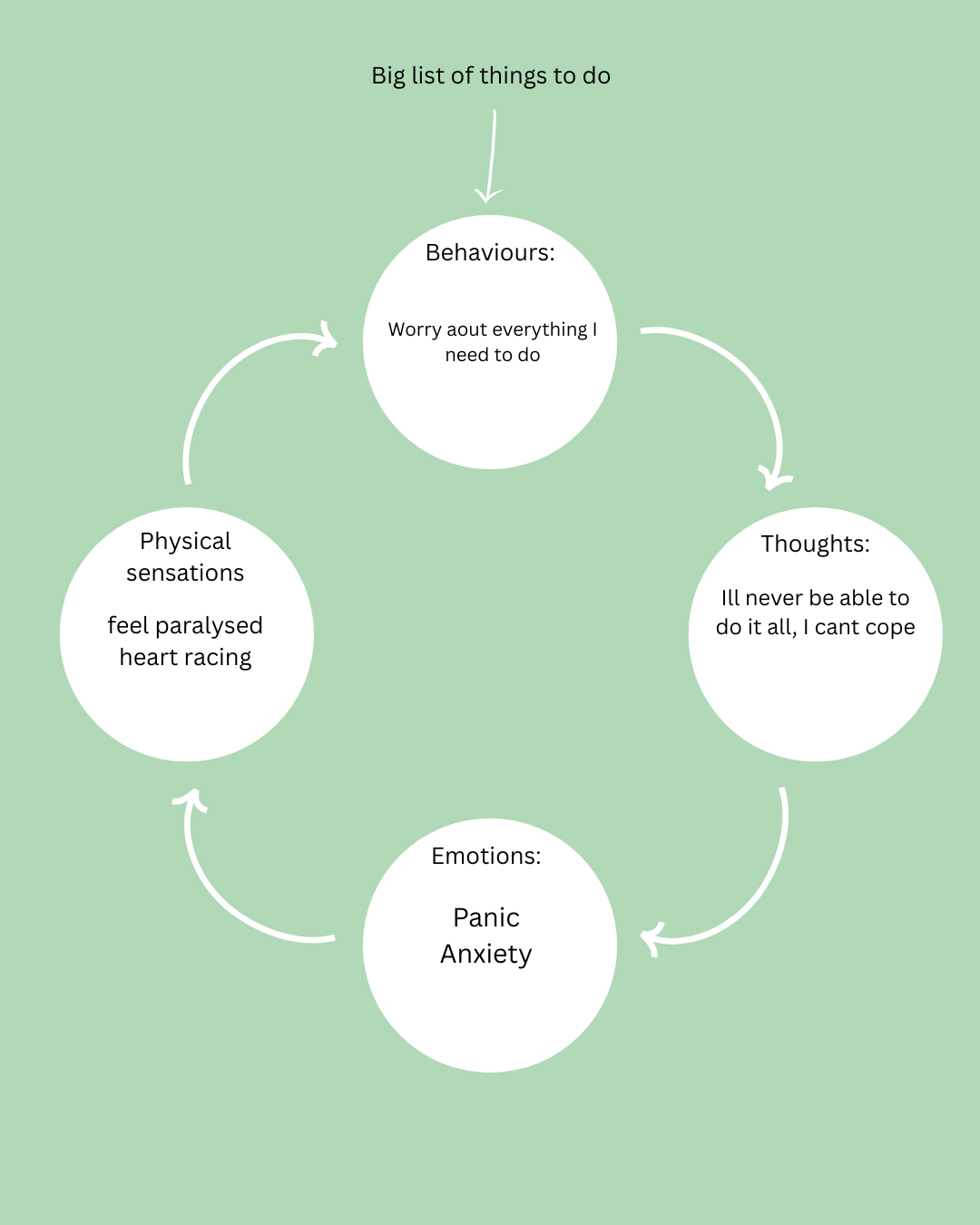
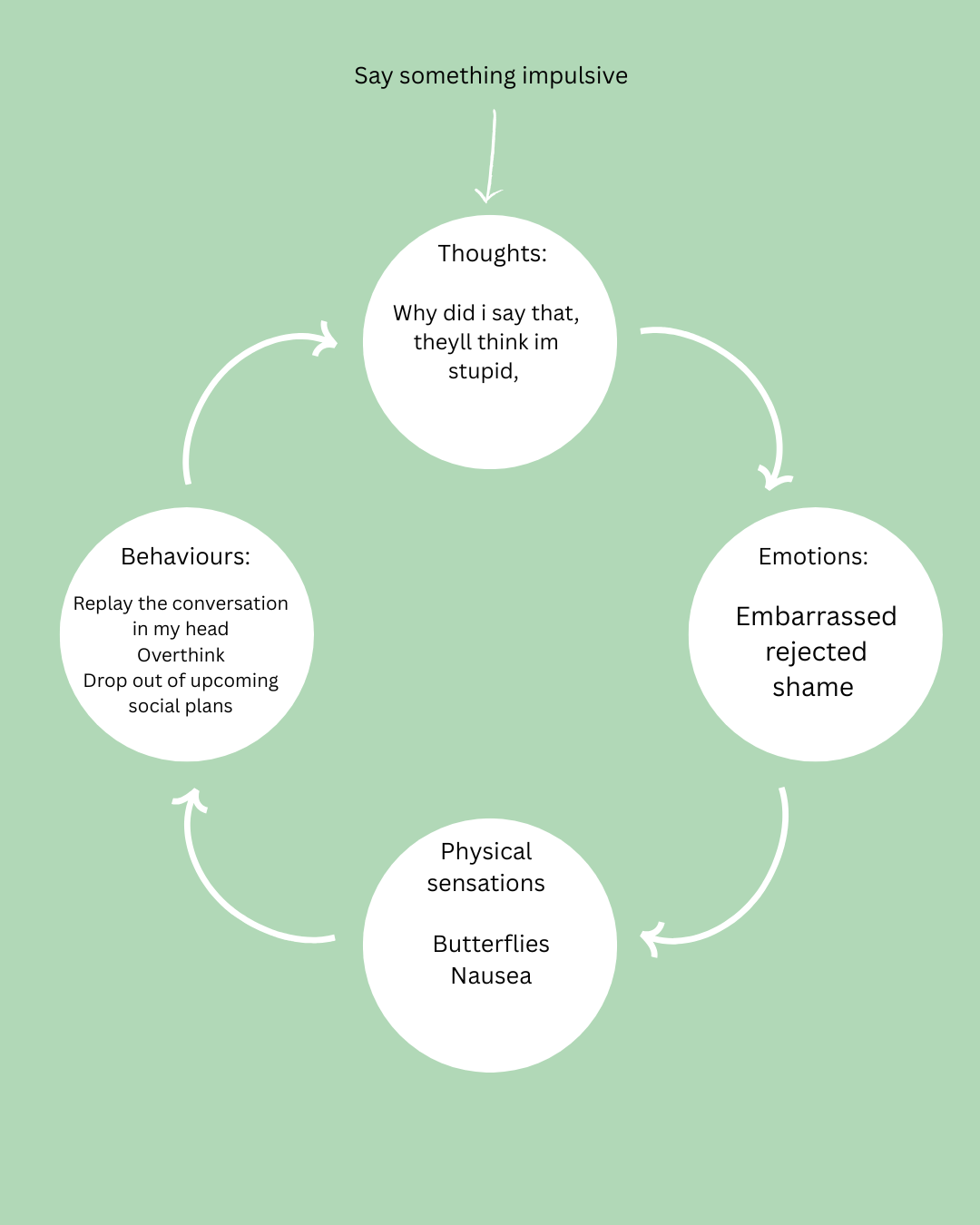
Therapy helps break the cycle.
One of the main goals of therapy is to identify the patterns that may be keeping you stuck and understand why they continue to repeat.
By breaking these cycles, we can begin to reduce overwhelm, challenge unhelpful thinking, develop healthier coping strategies, and build practical tools that help you work with your ADHD rather than against it.
How ADHD Therapy Can Help You
If you have ADHD, you probably already know exactly what you should be doing. The challenge is how to actually do it consistently.
You may have tried planners, productivity apps, routines, self-help books, or simply telling yourself to "try harder"—only to find yourself stuck in the same cycle of procrastination, overwhelm, burnout, or self-criticism.
ADHD therapy helps you understand what's getting in the way and develop practical tools, strategies, and systems that work with your ADHD, not against it.
Together, we’ll work towards helping you move from:
Procrastination & avoidance →Consistent action
Burnout → Sustainable routines
Overwhelm & chaos → Clarity, structure & calm
Self-doubt → Self trust
Feeling stuck →clear direction and consistent progress
Emotional reactivity → Emotional resilience
Perfectionism & fear of failure → Flexibility & self-compassion
Knowing what to do, but not doing it → Practical startegies that actually stick
Feeling stuck →moving forwards making meaningful, lasting progress
ADHD isn’t a lack of effort or willpower. Its a lack of the right tools, strategies and support.
How Adapted Therapy for ADHD is Different.
Many traditional therapy approaches weren't designed with ADHD brains in mind.
Standard therapy often assumes you can consistently plan, organise, remember, and follow through on strategies between sessions—the very areas ADHD tends to affect most. As a result, many people leave therapy feeling misunderstood, blamed, or frustrated that the approach simply doesn't work for them.
You shouldn't have to force yourself or mask to fit a therapy approach that isn't designed for the way your brain works.
That's why I use a powerful combination of evidence-based, research-backed therapies, adapted specifically for ADHD.
Rather than expecting you to fit the therapy, I adapt the therapy to fit you. My approach works with your ADHD, not against it.
Not a one-size-fits all approach.
Standard therapy wasn’t built with ADHD brains in mind. I provide therapy tailored to fit you and your ADHD.
My main approach is using Cognitive Behavioural Therapy (CBT) - a strong, highly researched and evidence-based approach, adapted for ADHD.
Alongside CBT, I draw on other powerful and holistic approaches to ensure therapy is tailored to your unique experience.
My Therapy Approach:
-
Cognitive behavioural therapy is a structured and goal focused approach that helps you identify and change unhelpful thought patterns or behaviours that may be contributing to your difficulties.
CBT is a highly researched evidence based therapy and is proven effective at treating a range of mental health difficulties. Its a recommended treatment by the National Institute for Health and Care Excellence (NICE) for various emotional difficulties.
-
Dialectal Behavioural Therapy (DBT) is an evidence-based therapy that stems from CBT. Its focus is on helping people manage intense emotions, improve communication and interpersonal relationships - all which can be common struggles in ADHD.
DBT has four core skill sets:
emotional regulation -managing difficult emotions so they dont take over
distress tolerance - manage sitting with distress and frustration.
Interpersonal effectiveness - communicating needs clearly with others and setting boundaries.
Mindfulness - being in the here and now, without judgement.
I incorporate skills from DBT into therapy as they provide essential tools to manage ADHD difficulties, especially managing overwhelm, regulate emotions, developing emotional resilience and self-awareness.
-
ACT (Acceptance and Commitment Therapy) is an evidence-based therapy that promotes acceptance of diffiuclt thoughts and emotions, rather than trying to suppress or fight them.
ACT can support people to acknowledge emotions, unhook from unhelpful thoughts and move forward in a way which is aligned with their values.
Research shows ACT can be effective for managing ADHD difficulties. Integrating skills from ACT with with CBT can create a powerful approach that addresses symptoms and live a more meaningful life
-
Compassion Focused Therapy) is a newer approach designed to support people who struggle with shame, elf-criticism and feeling not good enough - all which are common features among people with ADHD.
This approach integrates techniques from CBT, evolutionary psychology, neuroscience and mindfulness practice.
This approach helps people understand and balance their three emotional systems: threat (protection), drive (motivation) and soothe (calmness). CFT helps to balance these systems to foster empathy and develop self-compassion.
This approach can help people with ADHD manage their inner critic, reduce shame and generate genuine self compassion for themselves.
-
ADHD coaching is a practical intervention that specifically targets the core features of ADHD, including organisation, time management, goal setting and planning.
ADHD coaching is not a therapy and is more focused on providing personalised strategies to address the difficulties of ADHD. Coaching can help turn intention into actions, which is a struggle for many people with ADHD.
I draw on skills from this approach to implement practical, action-orientated strategies tailored to managing ADHD, into our therapy sessions.
-
Motivational Interviewing (MI) is a goal-orientated approach designed to strengthen someones motivation and elicit behavioural change.
This approach is not about imposing change on someone. Instead it helps to draw out the persons internal motivation for change and explores and resolve ambivalence for change This approach is rooted in promoting autonomy, self efficacy and self—compassion.
Motivational interviewing can be particularly helpful as a part of adapted CBT treatment. Especially for those feeling particularly demotivated or for people who struggle with task initiation and think ‘i just cant get started’.
About Me:
I'm a therapist for ADHD, with ADHD.
You don't have to over-explain, justify, or educate me about your ADHD, because I understand both personally and professionally just how much it can affect everyday life.
Using evidence-based therapies and the latest ADHD research, I help adults develop practical tools, strategies, and systems that work with their ADHD, not against it.
Because understanding ADHD is one thing. Learning how to manage it is another.

Australian Health Regulatory Agency (AHPRA) Registered Nurse (RN):
Registration number: NMW0004022945
Nursing & Midwifery Council (NMC) Registered Mental Health Nurse (RMN):
Registration number: 21F1498E



The First Step Towards Managing Your ADHD Starts Here.
Whether you've recently been diagnosed, are waiting for an assessment, or have been struggling for years, you don't have to navigate ADHD alone.
Together, we'll build practical tools, personalised strategies, and a deeper understanding of how your ADHD works—so you can spend less time surviving and more time thriving.
Book a free consultation to learn more.
Frequently Asked Questions (FAQs):
-
Cognitive behavioural therapy is a structured and goal focused approach that helps you identify and change unhelpful thought patterns or behaviours that may be contributing to your difficulties.
CBT is highly researched evidence based therapy and is proven effective at treating a range of mental health difficulties. Its a recommended treatment by the National Institute for Health and Care Excellence (NICE) for various emotional difficulties.
-
CBT sessions typically last 50 minutes. This is the standard duration for most cognitive behavioural therapy appointments. This will provide enough time to review progress, discuss current challenges, learn and practice new techniques, and set homework assignments.
Most people attend weekly sessions, though this can vary based on individual needs and phase in treatment. As therapy progresses and symptoms improve, sessions can become less frequent (biweekly or monthly).
The total number of sessions typically ranges from 4-20 for a full course of CBT treatment, though this depends on your individual needs, progress and goals for treatment.
-
This will completely vary person to person.
Many clients report feeling shifts within just 3-6 CBT sessions, though the number needed varies person to person depending on your difficulties, history and goals. Some notice shifts quickly, while more complex patterns may take longer to shift fully.
The aim is to start equipping you with practical tools, strategies, and new perspectives from the very beginning — so you can begin making meaningful changes as soon as possible.
-
It’s completely understandable to feel hesitant about trying CBT again if you’ve tried it before without success. You’re not alone in this and the experience can be quite common.
Previous experiences of standard therapy may have left them feeling frustrated or misunderstood.
CBT isn’t a one-size-fits-all approach, and there are valid reasons it may not have felt helpful in the past.
For people with ADHD, standard CBT can sometimes fall short if it isn’t adapted to your unique ways of thinking, processing, and functioning. Therapy that doesn’t acknowledge or accommodate the challenges of ADHD, including executive functioning challenges, emotional regulation difficulties, or the lived experience of neuro-divergence may mean that needs are unmet.
It’s also important to consider the relationship with the therapist. One of the most meaningful predictors of successful therapy is finding a therapist who understands your difficulties, feels confident working with them, and creates a space where you feel safe, respected and seen. Feeling a sense of safety and trust that the therapist “gets it” — can make all the difference.
The good news is that CBT can be adapted. When done in a neurodiverse-affirming way, it can be a powerful tool for navigating challenges, improving emotional difficulties and building strategies that actually work for you — not by trying to change who you are, but by supporting you as you are.
So while CBT doesn’t work for everyone, it might not be that CBT can’t work for you — it may just need to be the right kind of CBT, with the someone who gets it, at the right time.
If you're open to revisiting it, we can explore what didn’t work before, what you'd want to be different now, and how therapy can be tailored to fit you — not the other way around.
-
Yes, absolutely. Many of the people I work with may have ADHD, but come to therapy for reasons that go beyond their diagnosis— things like anxiety, low mood, low self esteem, burnout, or simply feeling overwhelmed and stuck.
Therapy is always focused on your specific needs and goals. Your ADHD does not have to be the main focus of your therapy. But I hold an awareness of how it might shape or influence the challenges you're currently facing and can recognise where this may be showing up.
For some people, its not about wanting help with their ADHD, but just wanting to be supported by someone who understands it. That’s more than okay too. We can hold space for whatever you’re going through, with or without ADHD being front and centre. -
Absolutely. You do not need a formal diagnosis to access support.
I understand the difficulties with trying to access an ADHD assessment currently in the UK. I welcome anyone who is seeking support with related to their ADHD, regardless if they have a diagnosis or not.
-
I completely understand how important getting a formal diagnosis can be. However, I do not provide formal ADHD diagnosis.
My focus is on supporting you to cope more and manage your ADHD related difficulties better - helping you to better understand yourself and your ADHD, improve symptoms and functioning through provision of tailored coping strategies and skills.
-
While I do work with people without ADHD in my NHS role, I believe in specialised therapy, which means it’s important to find a therapist who truly understands and feels confident addressing your unique difficulties.
If you’re querying whether you have ADHD or maybe you relate to many of the traits or information you’ve come across, then it’s very possible that you could still benefit from us working together.
That being said, if you feel fairly certain that ADHD isn’t part of your experience, it may not be the approach for you. In this case, I recommend having a free consultation call where we can explore further. This way, we can decide collaboratively if this is the right path for your support.
-
ADHD
Obsessive compulsive disorder (OCD)
Depression
Generalised anxiety disorder (GAD)
Social anxiety disorder (SAD)
Panic attacks and panic disorder
Low self-esteem
Confidence issues.
Sleep issues and disorders.
Perfectionism
Assertiveness
Work-related stress
Academic-related stress
-
Yes. I provide online ADHD therapy for adults throughout the UK, including London, Manchester, Birmingham, Bristol, Leeds, Edinburgh, Glasgow and surrounding areas. Online sessions allow you to access specialist ADHD support regardless of where you live.
-
Yes. I am a UK accredited therapist so many of my clients are based in the UK, however I also provide online ADHD therapy and ADHD coaching to adults internationally.
-
Although I am based in Sydney, Australia, I work online with clients throughout the UK and internationally.
Many of my clients are based in the UK, including London, Manchester, Birmingham, Bristol, Edinburgh and surrounding areas.
-
I work with adults (18+) with ADHD, including those who are newly diagnosed, awaiting assessment, exploring a possible diagnosis, or looking for support with procrastination, overwhelm, emotional regulation, executive functioning, and ADHD self-management.